For my first post on Tristan da Cunha click here.
For the first post on this voyage click here; for the second post click here.
When people discover I live on an island with fewer than one thousand inhabitants, they make what they think is a joke: you must know everyone! No joke: it’s almost true. When I was a kid we did seem to know everyone, even those of us who didn’t live there all year round. But now there seem to be more and more faces I don’t know. More cars I can’t identify either. But I do know I find it comforting, being familiar with the people around you. I like that we have shared history. I like that there are many people I know and spend time with who I would never have met in a city. On Flinders Island — of the coast of Tasmania — a great many people have known me since I was a child. And some of them don’t let me forget it!
But life on Tristan da Cunha takes the concept of knowing your neighbours and having a shared history to a whole new level. And there must be a great level of comfort in that too, since rarely do the Island-born leave. And for any pedant who is tempted to point out that these days most babies are born off-island, stop it. Those babies are still Island-born in my book, if that’s where their home was at the time of their birth.
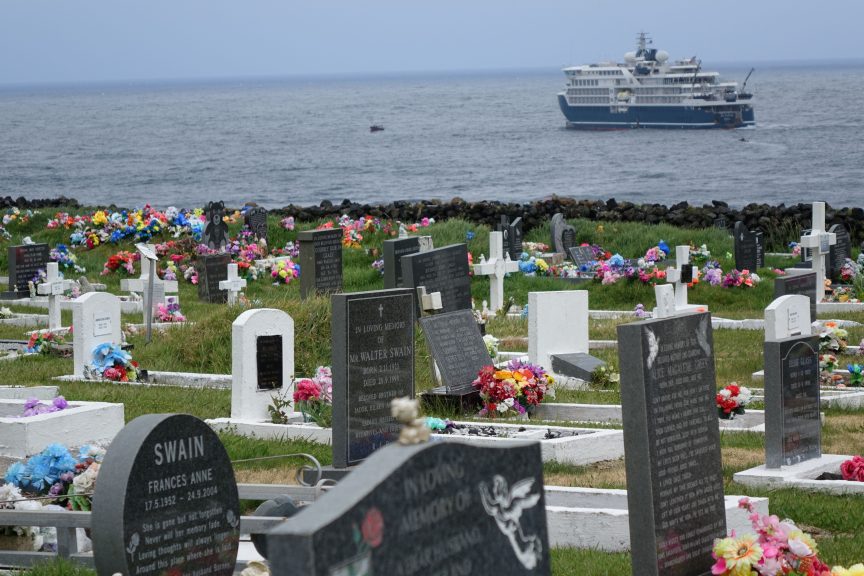
The cemeteries on Tristan da Cunha attest the closeness of this community and its shared and isolated history. And the care the locals take when it comes to their ancestors is evident.
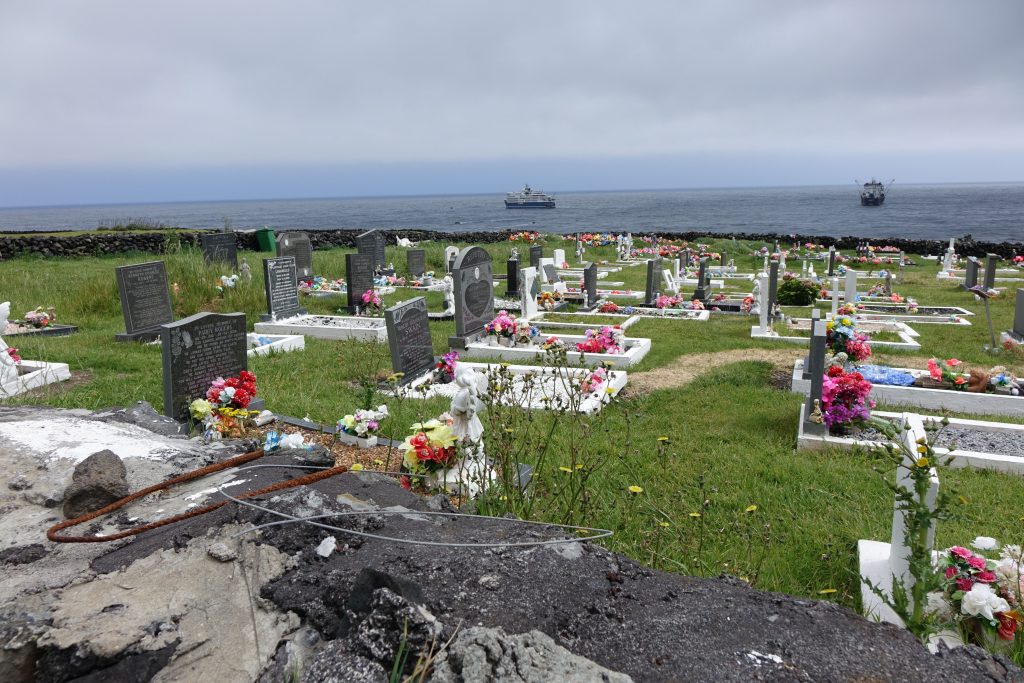
The cemeteries are surrounded by handmade stone walls. Possibly so the floral tributes don’t blow away so easily. And what floral tributes there are! Most graves are draped with pinks and blues, reds and greens.
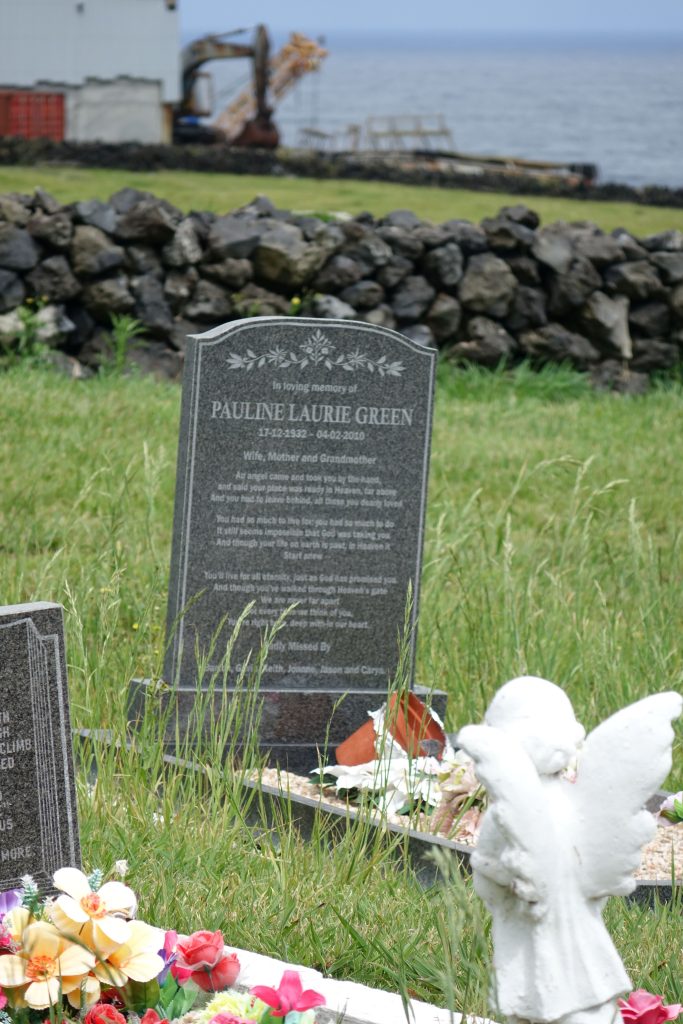
The remarks — often poems — that have been carved into the headstones are verbose. Usually much more than ‘Fred was here, 1968-2023’. Almost all of the available space on the headstone has been put to work in remembrance of the sorely missed. They are impressive.
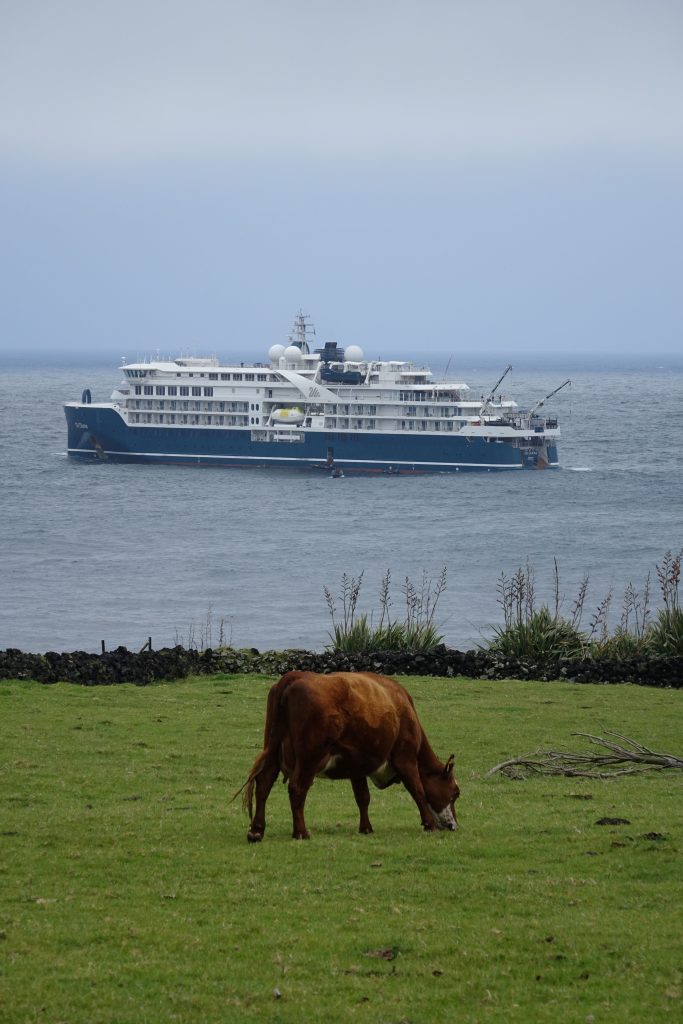
And the view from the cemetery is fabulous. When I look up, I can see the SH Diana anchored off shore. A Zodiac is zipping towards ‘The Settlement’ as the town, Edinburgh of the Seven Seas, is called locally. In the foreground, a brown cow munches on the long green grass that the Islander’s ancestors worked since the first settlement in 1810 to hard to cultivate.
The cemeteries are testament, in the main, to seven families. Headstones mark the final resting spots of Greens, Glasses, Rogers, Hogans, Laverettos, Reppettos and Swains. Plus a few others. Many of these people never left the island. Not ever. On Flinders Island I know people who hate to leave, some even who haven’t left in a decade or so. And we live only a plane ride away not nearly five days by ship. A Norwegian sociologist who visited in the later 1930s, noted that only six out of the then population of 80 or so had left its shores. Now, however, every Islander over 64 years of age has left the Island because the entire population was evacuated in 1961 when the volcano that is Tristan da Cunha, erupted (thanks to the webmaster of tristandc.com for pointing that out).
Rogers and Glass are two of the prolific seven surnames remembered in the cemeteries.
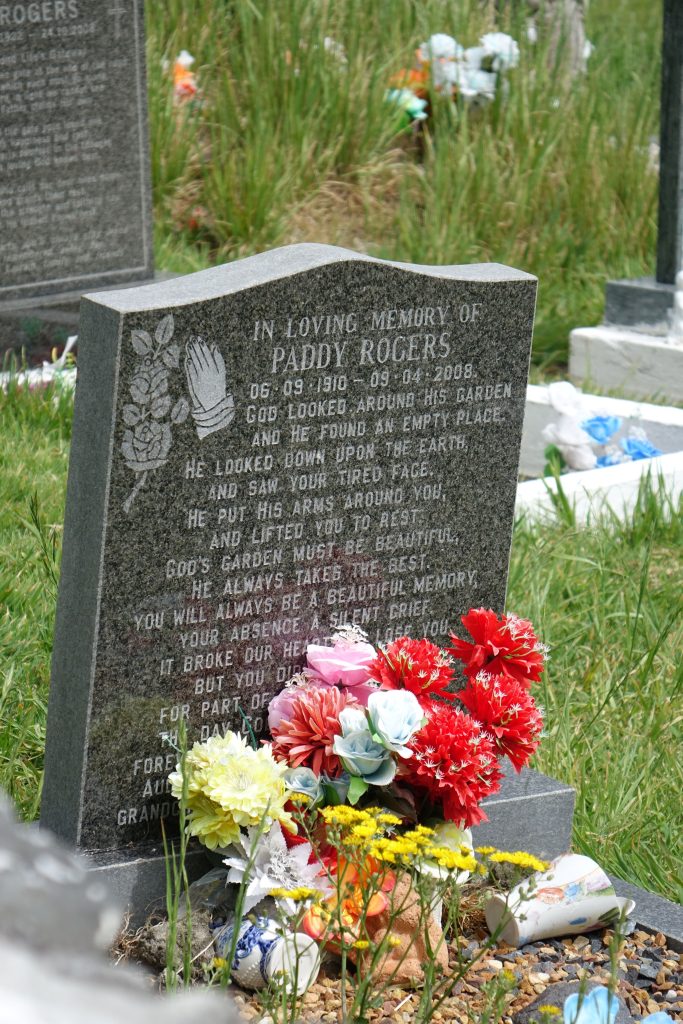
Paddy Rogers lived 98 years (left)
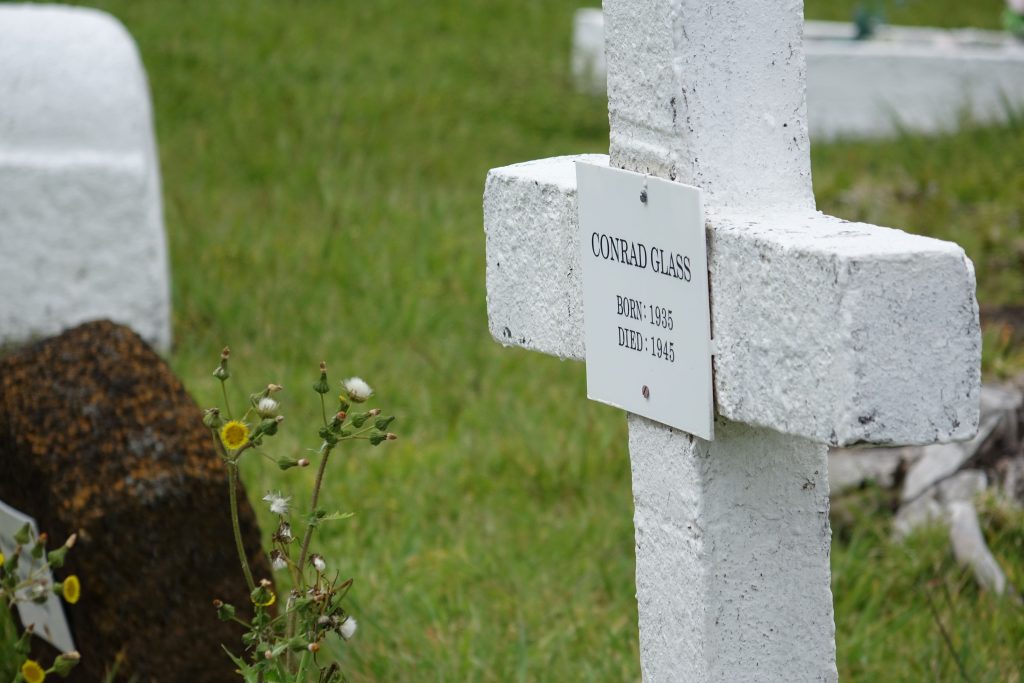
But Conrad Glass died aged ten. The plaque doesn’t say how he died. But sadly young deaths seem to be more common on remote islands where there is much water and limited medical care.
I know on our island deaths — any deaths — hit the community hard. When you don’t have many community members, each is extra-valuable. I can’t imagine how the TdC community is hit by a death when the deceased is surely certain to be a close friend, if not a relation. Unless, of course, it’s one of the few visiting workers the Tristinians call ‘station fellas’, such as the doctor or the Administrator appointed by the British Government.
On Flinders, funerals are well attended. On Tristan, I would lay money that ninety percent or more attend the service. And the wake. The grieving immediate family probably wouldn’t have to cook for a year, they’d find so many casseroles crowded into their ‘coolers’ as the locals call their fridges.
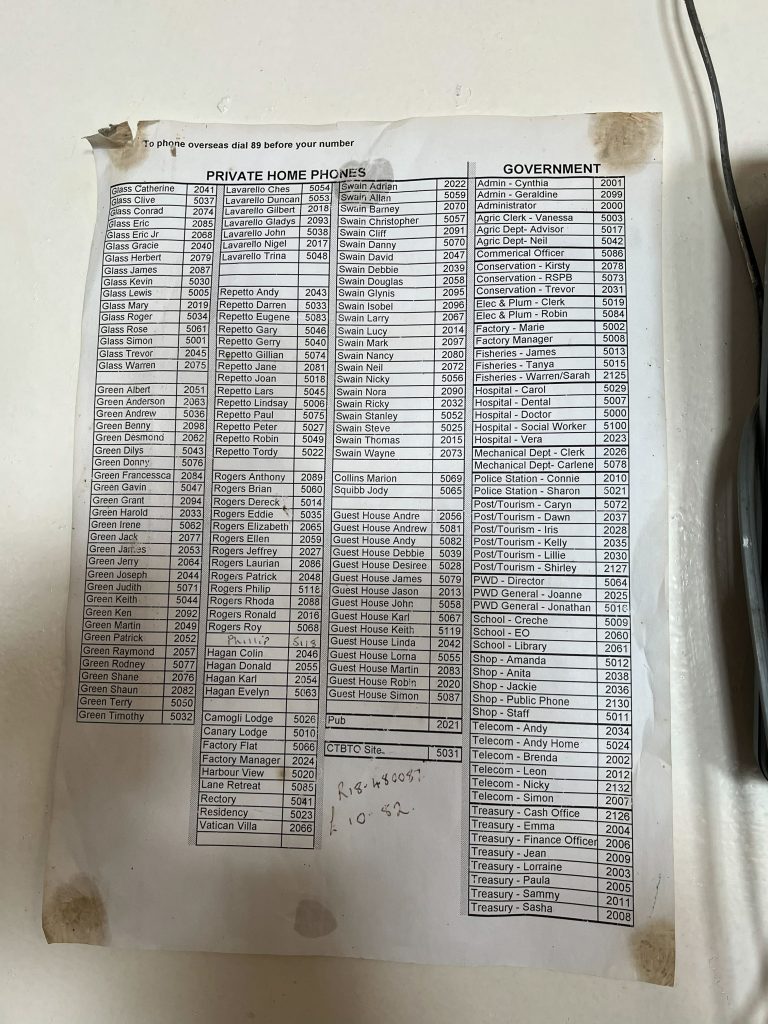
The phone book (or, rather, phone page) is also testament to the seven families. This one I spotted beside a phone hanging on the wall of the community’s sole bar.
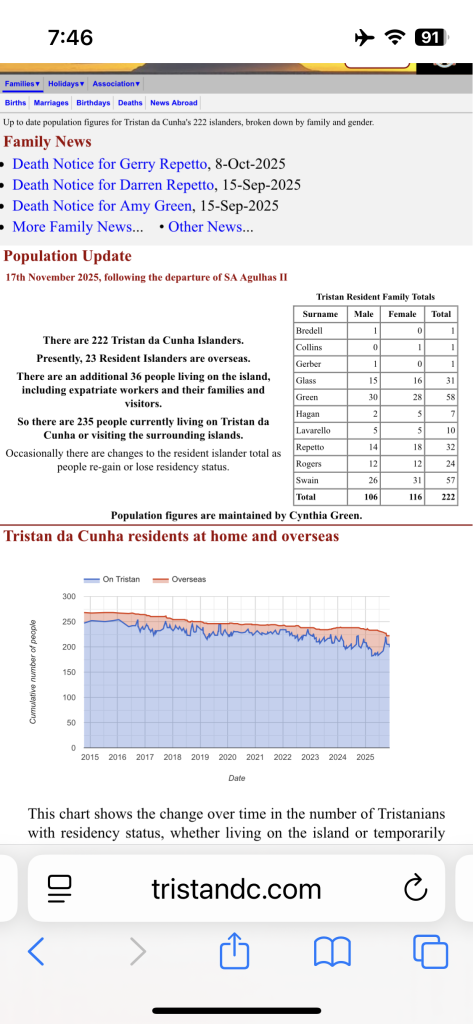
And here are the population figures, with surnames, as of a week ago. The chart includes the number of residents currently off-island and temporary residents and other useful demographic info.
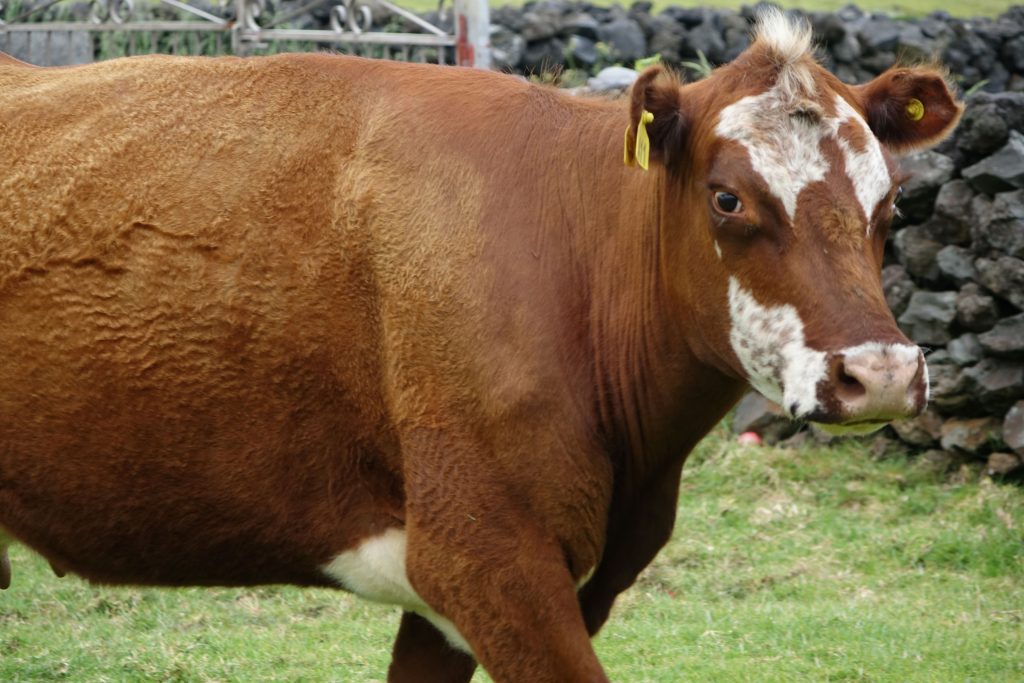
Each household can own one adult cow that roams around the settlement feeding on the green grass. The Department of Agriculture has the job of trying to overcome the natural acidity of the soil, maintaining fences and cattle grids. Here AI stands first for Artificial Insemination which has recently improved the gene pool for local cattle by the introduction of different breeds and two actual bulls imported to the island.
Sheep, fishing, tourism and potatoes are the other vital industries on Tristan da Cunha.
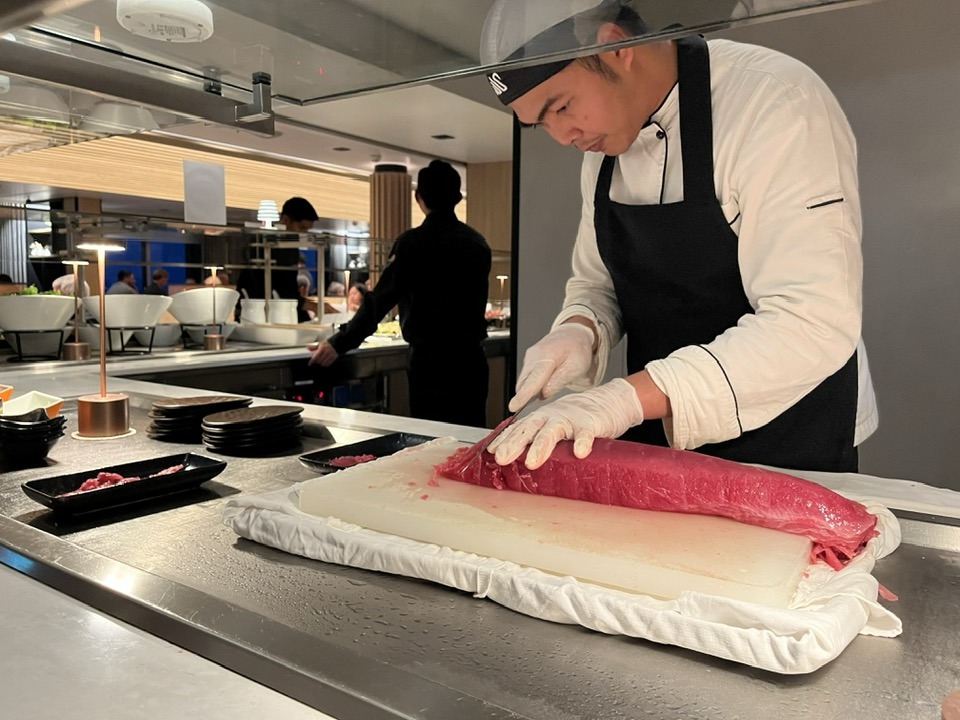
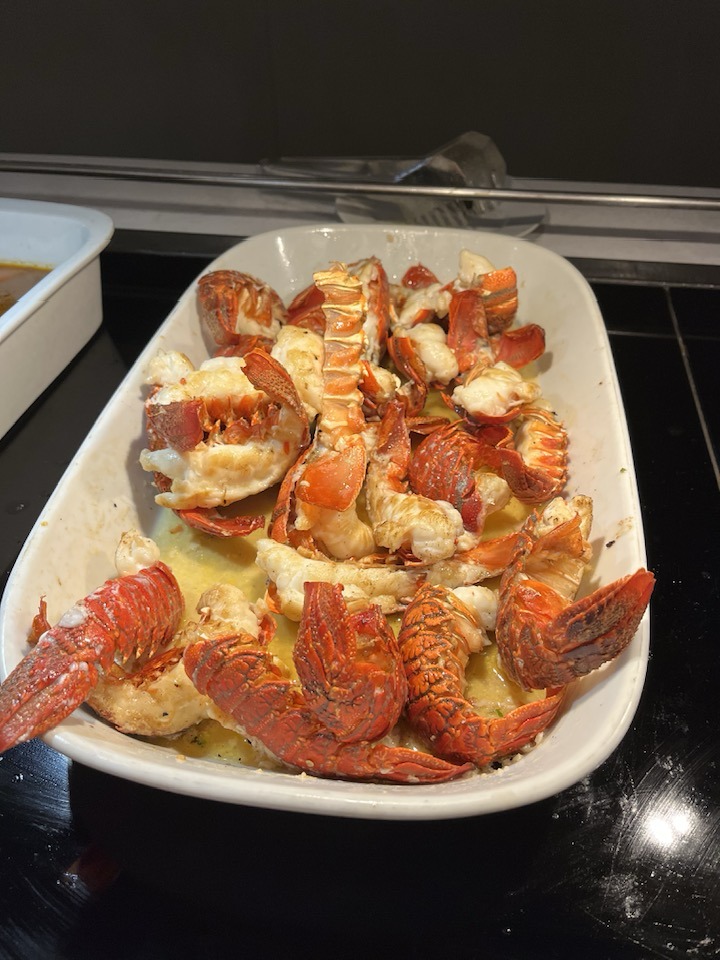
Our visit was not for long enough to satisfy me, but was long enough for the kitchen crew to buy crayfish tails for our dinner. The usually orderly queue for the dinner buffet resembled a high school rugby scrum scrambling after the toss.
It was very nice. More on TdC tomorrow.
For my first post on Tristan da Cunha click here.
For the first post on this voyage click here. For the second post in this series click here.